Showing posts with label Musee. Show all posts

Sunday, March 26, 2017

Van Gogh in Paris

Preparing a "France Van Gogh Tour" for the years to come, I enjoyed a lovely week end in Paris to check on location the organisation...

Van Gogh visited his brother Theo in 1873, 1874 & 1875 and settled there from Feb 28,1886 to Feb 18, 1888 where he was staying at his brother 54 rue Lepic next to Montmartre.

Best place to visit on the foot of Van Gogh is Montmartre, his flat, moulin de la galette, some restaurant which he was familiar with stayed alike.
Signpost on display by Moulin de la Galette

And of course, the main piece is the Musée d'Orsay with the largest collection of 27 Van Gogh in a French museum.
The place itself (a former train station) is just worth the visit and specialises in Impressionist artist located on the 5th floor.
Most of Van Gogh's works is displayed on the 2nd floor in a common room with Gauguin but some paintings are dispatched in other rooms of the museum.

Allow a minimum of 2 hours to visit the museum.
You can break your visit in the nice restaurant located on the 2nd Floor or the 2 café (ground floor and 5th floor).
Audio Guides are available in English from the desk.

Musée d'Orsay
open everyday but MONDAY
from 9.30 am to 6pm (late night until 9.45pm on Thursday)
Entrance fee 12 €
Audioguide 5 €
Avoid Sundays, prefer to come early in the morning and buy online to skip the queue
NO BACKPACK allowed even in the cloakroom
Free cloakroom.


Van Gogh trail in Montmartre

Van Gogh was here :)


The spirit of Montmartre

Musée d'Orsay entrance room

Magic of Paris

Melle Gachet in her garden, Auvers 1890

The Auvers Church, 1890

Autoportrait, Paris, 1887

Restaurant in Asnieres, Paris, 1887

The bedroom in the yellow house in Arles, St Remy, 1889

Top right corner of the painting with Van Gogh brother and sister

Auto portrait in St Remy, 1889

Restaurant on the 2nd floor

Café on the 5th floor

Sunday, March 19, 2017

Exhibition Paul Rebeyrolle at Musée Estrine Saint Remy de Provence 2017

Yesterday was the opening of the new exhibition at Musée Estrine in Saint Rémy.

Curator Elisa Farran was so happy to share Paul Rebeyrolle's work since it was on her bucket list since she joined the museum 10 years ago and today her dream comes true.

Reknown artist of the second half of the 20th Century, Paul Rebeyrolle who was considered as one of the major painter by philosophes such as Jean Paul Sartre  and Michel Foucault, revived the figurative painting after WWII.

Adept of the realism, Rebeyrolle added organic element such as straw, gravel, wood in his painting and the wild life plays a major role in his work.

The exhibition, running until July 23rd, features a large number of animal painting coming mostly from private collections.

If you like Bacon, you should like Rebeyrolle.

The first floor permanent exhibition is this year arranged around colour and emotion in painting.

Musée Estrine  
open everyday but Monday from 10am to 6pm (closed from noon to 2pm in April and Oct)
Entrance fee 7€
Joined ticket with the Van Gogh Fondation in Arles 12€
Audio guides can be rented from the desk for the  Van Gogh Interpretration Centre

Some history about the Musée Estrine 

Opening Day on March 18th 2017 Musée Estrine


Paul Rebeyrolle


Right : The daughter of the artist

View of a room of the permanent exhibition on the First Floor

"Three themes" 1934 by Saint Remy Artist Albert Gleizes

"Alicante" 2001, Thomas Fougeirol

"Eight bottle" 2000, Michel Potage

"Tryptic with no title" 2009,  Annabelle Milon
 

Sunday, March 5, 2017

2017 Van Gogh exhibition in Arles Fondation

I know spring on its way for the buds on my rose trees and the invitations to Museum opening.

That was the case on last Friday when I got the chance to discover 2 new exhibitions on the same day.

The Fondation Van Gogh in Arles just opened its new exhibition combining the works of Van Gogh and his influences on the work of Alice Neel.

The Van Gogh part shows 8 paintings, mostly from the E.G. Bürhle Collection in Zurich, from his early stage to the last part of this life.
I was thrilled to see that 3 out of the 8 paintings were from the Saint Remy time...

Alice Neel (1900-1984) was a New Yorker artist who specialised in Portrait "sans concession". The exhibition shows 71 of her portrait and shows us the influence of Van Gogh on her work.

Allow a couple of hours to discover this magic place (former National Banque de France).

Fondation Van Gogh
35 ter rue du Docteur Fanton
13200 Arles
(closeby to the Forum square)
Every day 9am to 7pm as from April 1st
Last entrance 6.45
This exhibition will run until September 17th 2017

Entrance 9 €.
For Saint Remy visitor, a pass including Musée Estrine in Saint Remy is available at 12 €.


Entrance of the Van Gogh Fondation in Arles


Peasant woman head 1885 Nuenen (NL), the early stage (Bürhle Fondation Zurich)

Olive Orchard Saint Remy 1889 (Private collection)

The Weeders Saint Remy 1890 (Bürhle Fondation Zurich)

Entrance to the quarry, Saint Remy July 1889 (Van Gogh Fondation Amsterdam).

Gerard Malanga 1969

Margaret Evans Pregnant 1978

Joe Gould 1933
 

Saturday, June 11, 2016

Vasarely Exhibition in Gordes Summer 2016

I was waiting for it, for the reason that the castle in Gordes was closed for visit while I was touring there.
I was in Gordes for the opening on June 2nd of the new Victor Vasarely exhibition and was not disapointed.

Victor Vasarely discovered Gordes in 1948 and found in love immediatelly as we all do. He opened a "didacted museum" in the Castle of Gordes in 1970. The Museum just closed prior to his death in 1997 but the town kept a close link with the artist and are thinking about a permanent collection back in the castle.

The current exhibition last until October 2nd
Opening time 10 to 12.30 and 1.30 to 6pm
Entrance fee 7 €

Amongst the numerous pieces exhibited, you can admire 5 tapestries from Aubusson, pictures about the artists, sculptures and numerous drawings and painting.

If you don't know Vasarely, this is the perfect opportunity.
If you don't like Vasarely, just go in for the Renaissance Chimney on the grand first floor room and the beauty of one the nicest Castle in Provence 

What else to say other than "enjoy"...


The First floor room with its gigantic Renaissance chimney


Sunday, March 29, 2015

Roussillon : Everything about the Ochres...

It has been on my check list for a long time so when I got the invite, I jumped on it.

I attended on Friday a special visit of the Ochre Mine of Bruoux and the Usine Mathieu, known as the conservatory of the Ochres for an afternoon in a world of coulours in Roussillon...

Ochre was mined in the region of Roussillon since the paleolithic time and industrialised from the mid 19th Century until the mid 20th C.
Its pigment has and is still used as a dye for paint but its industrilisation came for its clay that was used as a "skeleton" for the rubber industry.
Decline in the mid 20thC is explained by the discovery of the use of petrol  waste for the rubber, a cheap and easy to find material.


Our visit started at the Mines de Bruoux.
Guided visit only in an amazing maze of 40km... (about 25 miles).
We grabbed our yellow building site hat, our little "tag number" (to check that noone go lost in the cave...) and followed the guide.
You'll walk with your guide in the moutain. The galleries are 15m (50ft) and were all carved naturally in the sandy cliff. At some point you'll feel like entering a colourfull cathedral.
You'll understand how man would carve the cliff from ground level to the top, using only small tools.
Visit lasts about 50mn, check the schedule for visit in English

- Visit only in group of Max 25 people ==> Wise to book in advance
- Dont forget your sweater as temperature in the mine is of 10°C all year round (50F)


 Then on we went to the Conservatoire des Ocres / Usine Mathieu
At the begininng  of the 20th C, Roussillon has over 20 factories employing more than a 1 000 persons to extract the pigment from the Ochres.
Today, the usine Mathieu is the only place that has been kept alive to tell the story.
A nice little path with signs explains you the journey of the extracted rock....
1 -  The colouring :
The rock is yellow to red in colour. Naturally yellow, the ochre turn red by oxydation. So if you extract yellow rock and want it turned into red, you have  2 solutions. One: wait a few hundred years, or two: warm it up to speed the oxydation.
The first stop shows the "ochres bakery" were you would heat up your rocks until you hear a little "crack" that would advise you that red is ready... If you dont heat it up enough, the outside will turn red when the inside will remain yellow. Mix yellow and red and you'll get an orange....

2 - you crush the stone, like you would when doing Olive oil.

3 - You mix the powder with plenty of water. The flow will go into a filtration maze. Sand will progressivly be separated from the pigment.

4 - In the final filtration stage, the ochre pigment will be left to dry in a pond, and broken into 25kg stones that will dry under our summer sun.

5 - The pigment will be again crushed, and go through the last filtration system using silk fabric filter.
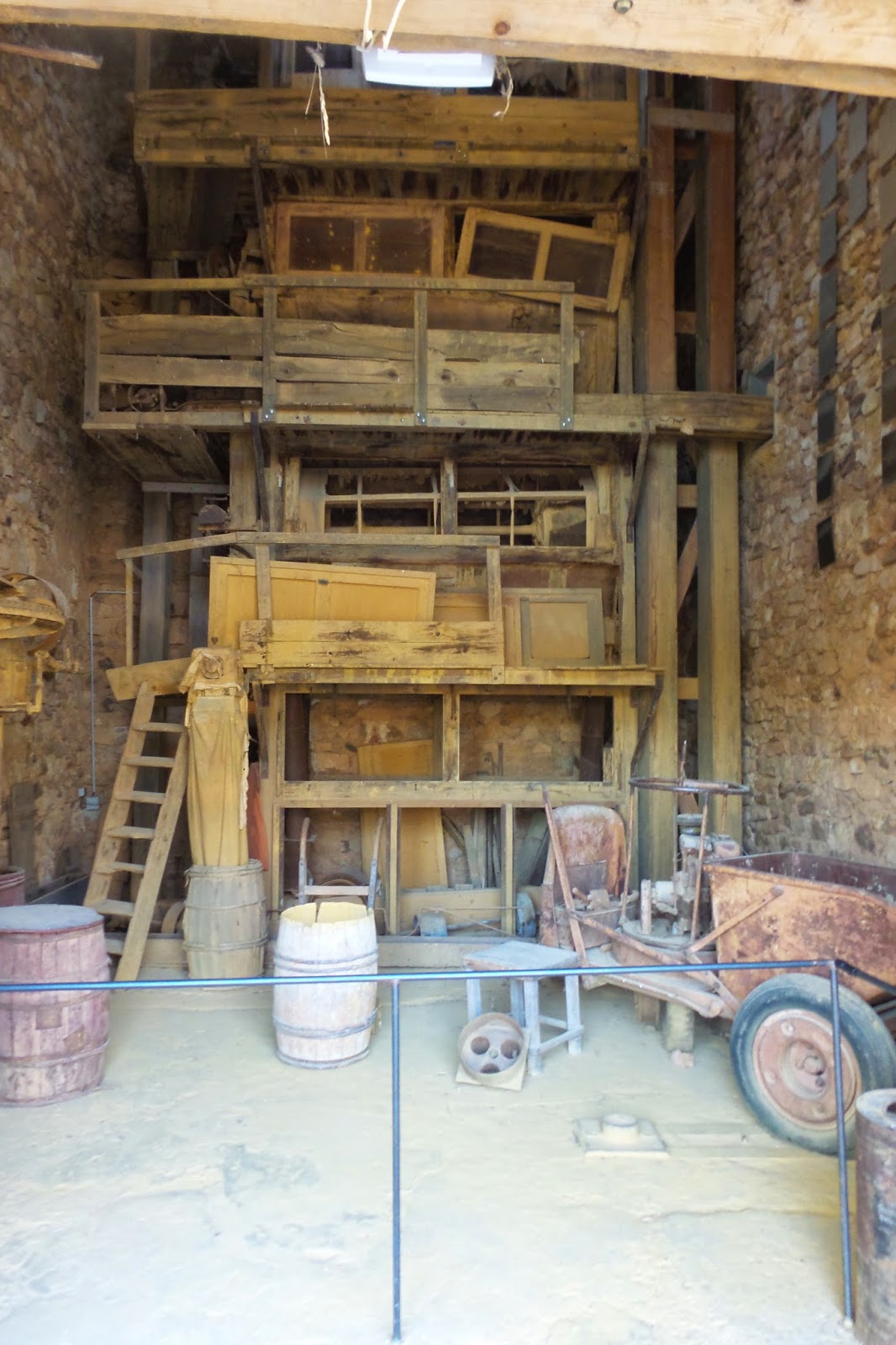
Just shove it in a bad and mail it...

Mining and filtration and final preparation would happen in the winter when water was around, letting the local plenty of time in Spring and Summer to deal with farming works.

At the Conservatory of the Ochres, you may also follow a workshop around Ochre paint. Whether you want to repaint your house (as the local have to do because of  a town hall law that forbid them from using any other type of paint for the outside of their house), or reproduce a Van Gogh...


The Ochres Mines of Bruoux


40km of maze in the Ochres Mine..... 


Conservatory of the Ochres / Usine Mathieu


Turning from Yellow to Red


Crushing and washing the Ochres

First stage of filtration, the sand will stay at the bottom of the tank
Last filtration and drying of the ochre

Separation of the Yellow pigment

Ochres workshop room